Interpretation Guide: Reading Your Financial Self
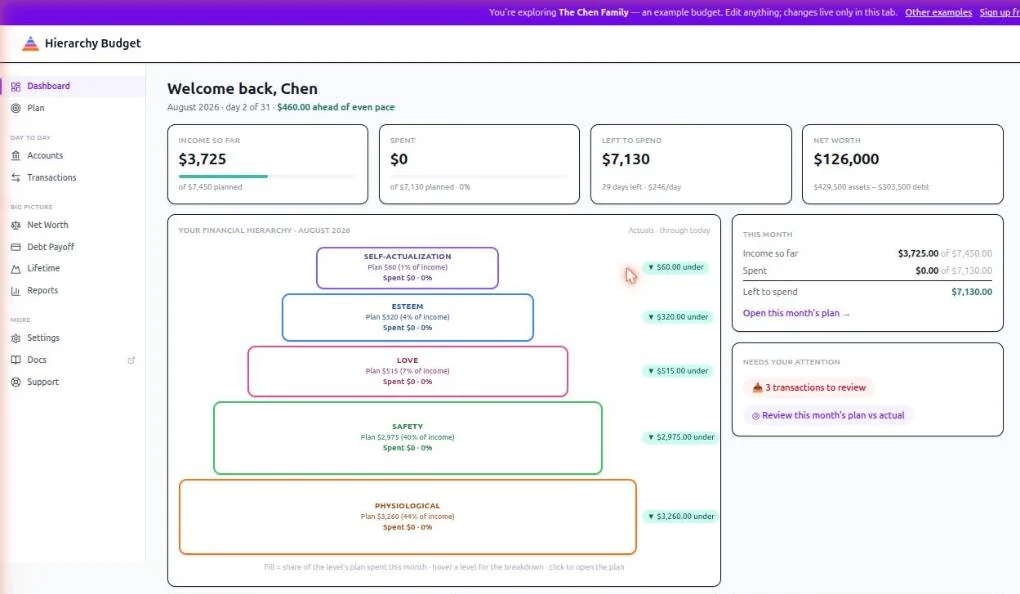
View your budget at Monthly Budget and your hierarchy at Dashboard.
What Your Budget Reveals
Your budget is a psychological document. It shows which human needs are calling for your resources - and how much attention each is getting.
The Bandwidth Tax and Your Hierarchy
One critical finding from scarcity research: When resources are tight at foundational levels (physiological, safety), cognitive capacity shrinks. Your mind becomes consumed by those needs. You have less mental bandwidth for planning, decision-making, and strategic thinking.
Maslow observed this exact phenomenon in 1943: “All capacities are put into the service of hunger-satisfaction… Capacities that are not useful for this purpose lie dormant, or are pushed into the background.”
This matches what behavioral economists Mullainathan and Shafir found decades later: scarcity captures the mind. When lower needs consume most resources, you have less mental bandwidth for:
- Strategic planning
- Long-term thinking
- Creative problem-solving
- Relationship building
- Impulse control
This is not a character flaw. This is what scarcity does to any human mind.
The hierarchy visualization shows you when you’re in this state. If the bottom two levels consume 75%+ of your budget, you’re likely experiencing cognitive scarcity effects, making it harder to think your way out. This awareness doesn’t solve the problem, but it explains why budgeting feels impossibly hard when money is tight - and why you may need external support, not because of personal weakness, but because scarcity itself limits the mental resources available for self-improvement.
This guide helps you read what the numbers reveal.
The Five Levels
Physiological: The Foundation
Food, water, shelter, sleep, health. The body’s non-negotiables.
What allocation might reveal:
-
Very high (75%+): Resources are being consumed by survival needs. When this much mental and financial energy goes to physiological needs, cognitive capacity suffers. The scarcity becomes self-perpetuating - it’s hard to think strategically when meeting basic needs consumes everything.
-
Very low (under 10%): Either extraordinarily efficient with basics, or these needs aren’t truly being met.
-
Growing over time: Either actual needs are increasing, or lifestyle inflation is happening at the foundation.
Questions to consider:
- Is what I’m calling “physiological” actually comfort spending?
- Is my housing cost appropriate for my income?
- If this is consuming 75%+ of my budget, am I aware this scarcity is affecting my cognitive capacity?
Safety: The Stability Layer
Insurance, emergency funds, debt payoff, retirement. Freedom from chronic anxiety about “what if.”
What allocation might reveal:
-
Very high (50%+): Either in genuine recovery from instability, or anxiety is driving choices beyond what the numbers require.
-
Very low (under 10%): Either supremely confident in stability, or avoiding the work of building security.
-
Debt-focused exclusively: Fighting to get stable. If sacrificing all other needs - belonging, meaning, basic self-care - this pattern shows single-focus allocation.
Questions to consider:
- Is my safety spending building actual security, or feeding anxiety that can’t be fixed with money?
- If I feel unsafe despite high spending here, what’s the real source?
- Am I mortgaging present self (connection, growth, joy) for a future that may never feel safe?
Love & Belonging: The Connection Layer
Phone, internet, social activities, gifts, family time, pets, community.
What allocation might reveal:
-
Very high (30%+): Significant resources going to connection-related expenses. The pattern shows whether this is building connection or attempting to buy it.
-
Very low (under 5%): Either chosen solitude or isolation being denied.
-
All gifts, no time together: Pattern suggests attempting to purchase belonging instead of building it through presence.
Questions to consider:
- Are my belonging expenses actually creating real connection, or simulating it with spending?
- Am I spending on people I genuinely care about, or on people I want to impress?
- If this is very low, am I choosing solitude authentically, or am I isolated and denying it?
Esteem: The Respect Layer
Gym, appearance, hobbies, professional development, quality items, status symbols.
What allocation might reveal:
-
Very high (25%+), especially on status items: Significant resources going to respect-seeking purchases. New car barely affordable, designer labels, items chosen to prove something.
-
Very low (under 5%): Either made peace with self, or given up on self-investment.
-
Misalignment: Spending here but not feeling better about self. The spending isn’t meeting the underlying need.
Questions to consider:
- Are these purchases building real confidence in myself, or am I trying to impress other people?
- If no one would ever know about this purchase, would I still buy it?
- What do I actually respect about myself? Am I investing in those things?
Self-Actualization: The Growth Layer
Creative projects, meaningful education, transformative travel, legacy work, deep personal growth.
What allocation might reveal:
-
Very high (20%+) while basics are shaky: Significant resources going to growth while foundation shows underfunding.
-
Always zero: Life is maintenance. Either in a season where basics genuinely need everything, or stuck and afraid.
-
Labeled as growth but it’s consumption: Expensive vacations, courses not completed, hobbies abandoned. Pattern shows spending for comfort labeled as growth.
Questions to consider:
- If I’m spending heavily here, is it because I’m genuinely thriving, or because I’m avoiding something harder below?
- If I’m spending nothing here, is it because I must right now, or because I’ve stopped believing in my potential?
- Is what I’m calling “growth” actually just consumption in a different package?
Common Patterns
Pattern: Top-Heavy Hierarchy
Significant spending on top levels (esteem/actualization), limited on bottom (physiological/safety)
What this reveals:
- Basics may truly be solid
- Or: foundation shows underfunding while higher levels get attention
Questions to consider:
- Are basics truly met, or am I in denial about foundation instability?
- Is this sustainable?
Pattern: Bottom-Locked Hierarchy
80%+ on physiological and safety, minimal for higher needs
What this reveals:
- Income genuinely only covers basics
- Or: anxiety is driving choices
- Or: recovering from trauma/instability
- Or: “basics” spending contains lifestyle inflation labeled as necessity
Questions to consider:
- Is this my reality right now, or my fear about my reality?
- Is my cognitive capacity being affected by this scarcity?
Pattern: Missing Middle
Significant spending on physiological/safety and esteem/actualization, minimal on belonging
What this reveals:
- Either satisfied in solitude
- Or: isolated and compensating with achievement and productivity
Questions to consider:
- Am I actually satisfied in solitude, or am I isolated and avoiding it?
- Am I using achievement (esteem/actualization) to compensate for lack of real connection?
Pattern: Swinging Budget
Budget changes dramatically month to month
What this reveals:
- Life is actually unstable (job insecurity, relationship turbulence, health issues)
- Still finding rhythm (normal when starting out)
- In transition phase (moving, career change)
- Or: impulsive spending masking multiple unmet needs calling loudly
Questions to consider:
- What’s causing the swings?
Pattern: Scarcity at Foundation
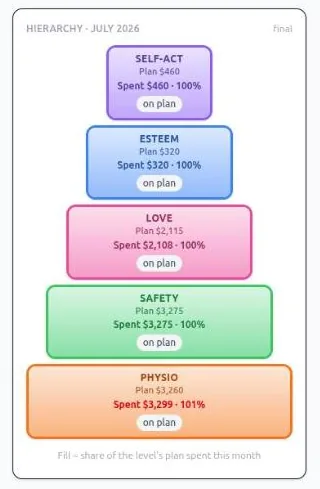
75%+ going to physiological and safety needs
What research shows: When this much of budget and attention goes to lower-level needs, cognitive capacity contracts.
What this means:
- Less mental bandwidth for planning, strategic thinking, decision-making
- More vulnerable to impulsive spending (self-control requires mental energy)
- The scarcity itself makes it harder to think your way out
- This is what scarcity does to any mind
The insight: This budget pattern indicates cognitive capacity is being affected by scarcity. May require external support - not because of weakness, but because scarcity itself limits mental resources available for self-improvement.
Questions for Reflection
After viewing your hierarchy, consider these questions. No pressure to change anything. This is about seeing clearly.
Awareness
- What surprised me about where my money actually goes?
- Which need feels most unmet, regardless of how much I’m spending on it?
- Where is the biggest gap between what I’m spending and whether it’s actually fulfilling the need?
Alignment
- If someone looked at my budget, what story would they tell about what I value?
- What do I say matters to me vs. what does my spending reveal?
- Where am I spending on autopilot, without real awareness?
Honesty
- What do I wish were different about my budget?
- Which need, if better met, would reduce stress or suffering in my life?
- What’s the one thing I’m not willing to see clearly?
What the Numbers Show
The goal isn’t a “perfect” budget or “correct” percentages. The goal is clarity.
When you see your budget clearly, you can ask honest questions:
-
If spending heavily on restaurants/socializing: The pattern shows resources going to connection-related expenses. Are these building real connection, or attempting to buy belonging?
-
If debt payments dominate: The pattern shows resources going to building safety. This is what the situation calls for right now.
-
If spending nothing on growth: The pattern shows everything going to survival and stability. Either in a season where basics genuinely need everything, or stuck.
Your budget reveals what’s actually motivating you. It doesn’t lie.
The question is: once you see it clearly, what will you choose to do with that knowledge?
What the Patterns Mean
Understanding how needs work together - what Maslow called “prepotency” - helps interpret what your hierarchy reveals:
When Lower Needs Dominate
If physiological/safety needs consume most resources (75%+), they’ll dominate mental space. This is what Maslow observed: “All capacities are put into the service of hunger-satisfaction.”
The pattern shows scarcity at the foundation. This taxes cognitive capacity, making it harder to plan or think strategically about anything else.
The Trade-off Pattern
A $200 gym membership serves esteem needs. But if it prevents building an emergency fund (safety), the unmet safety need creates background anxiety. The pattern shows resources going to a higher level while a lower level remains unstable.
Maslow observed that unsatisfied lower needs continue pulling for attention, even when higher needs are being addressed. The anxiety from the lower level undermines satisfaction from the higher level.
Higher Needs Calling
When basics are stable but zero allocation goes to growth, connection, or meaning, the pattern shows all resources going to maintenance.
Maslow noted that when higher needs emerge, they can dominate consciousness just as powerfully as hunger. The person making $80K who feels broke because esteem and self-actualization needs are calling isn’t being dramatic - they’re experiencing real psychological pressure from unmet needs.
Partial Satisfaction Across Levels
Maslow provided rough estimates for an average person: 85% physiological, 70% safety, 50% love, 40% esteem, 10% self-actualization.
The pattern shows partial satisfaction across all levels simultaneously, not perfect satisfaction at lower levels before addressing higher ones. This matches how human needs actually work.
Misaligned Spending
When spending heavily on a need but feeling no satisfaction, the pattern suggests spending on a proxy. Status items purchased for esteem when the actual need is connection (love). Entertainment spending (physiological pleasure) when the real need is security (safety).
The hierarchy reveals these misalignments.
“The study of motivation must be in part the study of the ultimate human goals or desires.” - A.H. Maslow
Related Pages
- Dashboard - View your hierarchy visualization
- Monthly Budget - Your monthly income and expenses
- Cash Flow - Forecast vs actual comparison
- Philosophy - The theory behind the hierarchy