Debt Payoff
See how long your debt takes to clear, what the interest costs, and what changes if you attack it differently. Go to Debt Payoff to get started.
Your Debts
The Creditor information table at the top holds every debt: name, balance, APR and minimum monthly payment. Changes save automatically as you type, and the row at the bottom adds a new one.
These are the same debts as your Net Worth page - one list, two views. Editing here changes your net worth, and vice versa.
Two kinds of debt end up in this table:
- Linked debts - credit cards and loans that are real accounts with a register. Their balance is live: it amortizes from whatever today’s register says, so paying the card down is reflected without you retyping anything.
- Manual debts - a balance you typed, for anything you don’t track transaction by transaction.
Your Payoff Plan
Two inputs decide everything:
Strategy - the order you attack debts in.
| Strategy | How it works |
|---|---|
| Highest interest first | Extra money attacks the highest APR. Pays the least total interest. |
| Lowest balance first | Extra money clears the smallest debt first. Quick wins, steady motivation. |
| Minimum payments only | No extra payments. The slowest and most expensive path - useful as a baseline. |
Total payment / month - everything you put toward debt each month, across all of it. It has to be at least the sum of your minimums; the card tells you what those come to. Whatever you put in beyond the minimums is the extra that attacks your target debt, and the page says exactly how much that is.
Saving the plan
Save plan sets an anchor: the strategy, the payment and the date you committed to them. Future visits grade your real progress against that date, so the page can tell you whether you’re ahead or behind the plan you actually chose - not just what’s mathematically optimal today.
Until you save, what you’re looking at is a what-if. Change the strategy and payment freely to explore.
Strategies Compared
The Strategies compared card runs all three at your current payment and shows them side by side: debt-free date, months, total interest, and what each saves against minimums-only.
Sometimes two strategies are identical - if your debts happen to be ordered the same way by balance and by rate, snowball and avalanche do the same thing. When they differ, the difference is the real cost of choosing the motivating option over the optimal one.
The mathematically optimal strategy isn’t always the best one for you. If lowest-balance-first keeps you going and highest-interest-first doesn’t, the extra interest can be money well spent. Pick the one you’ll stick to.
What This Plan Does
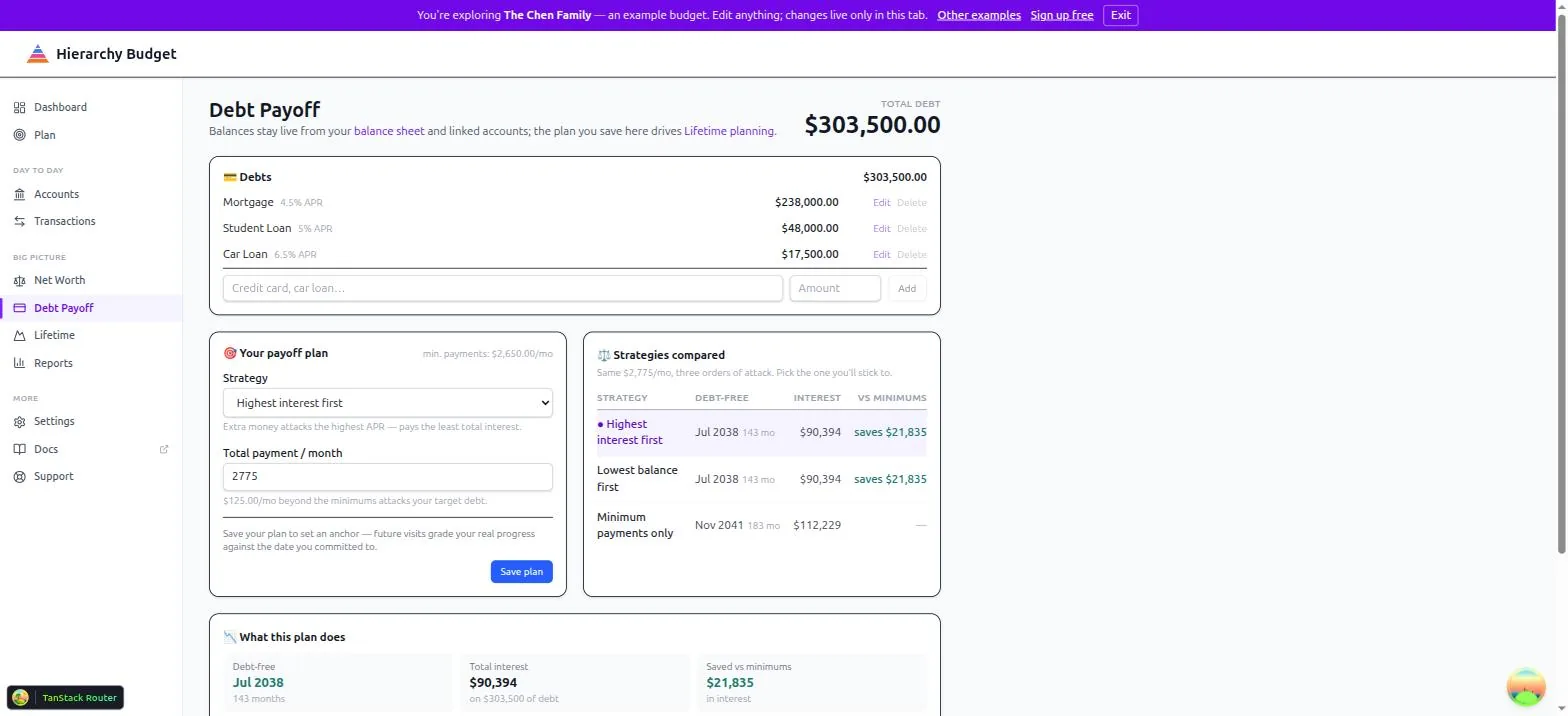
The results card gives you:
- Debt-free - the month you make the final payment, and how many months away that is
- Total interest - what borrowing costs you over the life of the plan
- Saved vs minimums - interest avoided by paying more than the minimum
Below that, your debts in payoff order, each with the month it clears and the interest it costs.
The snowball effect
When one debt clears, its payment doesn’t disappear - it rolls onto the next one. That’s why the later debts in the list clear faster than their balances suggest, and why the total payment matters more than which debt you start with.
The full schedule
Full schedule expands the month-by-month detail: payment, interest and remaining balance for every month until you’re clear. Export it as CSV or PDF.
Where This Shows Up Elsewhere
The saved plan drives Lifetime Planning - the debt line in your long-range projection uses this strategy and this payment. That page reports in whole years; this one gives you the exact month. The strategy dropdown at Settings > Projections is the same setting seen from the other side.
Common Questions
Why is my interest so high? Usually a long timeline. A minimum payment that barely exceeds the monthly interest charge means the balance hardly moves, and years of carrying it add up. Raise the total payment and watch the interest figure drop.
Should I pay debt or save? As a rough rule, clear high-interest debt (above about 7%) before saving aggressively, but keep a small emergency fund first so a surprise doesn’t put you back on the card. This is general information, not advice for your situation.
What about a 0% promotional rate? Enter the promotional rate and watch the date. If the promo expires before the plan clears it, you’ll want to pay it down faster than either standard strategy suggests.
My debt-free date is years away. Is that hopeless? No - it’s information. It’s also the number that moves the most when you change the total payment, which is worth trying before deciding anything.
Can I trust the numbers? The math is standard amortization. Results are estimates: they assume rates hold, payments are made, and no new debt appears. Linked debts amortize from today’s register balance; manual debts from the balance you entered.
Tips
Be realistic about the payment. A number you can’t sustain produces a date you won’t hit. If your income varies, base it on a bad month.
Come back and update. Balances, rates and what you can afford all drift.
Extra money speeds things up. A refund or bonus put against your target debt re-cuts the whole schedule.
Related Pages
- Debt Payoff - Run the numbers
- Net Worth - The same debts, in context
- Lifetime Planning - Debt inside the long view
- Settings > Projections - Projection assumptions