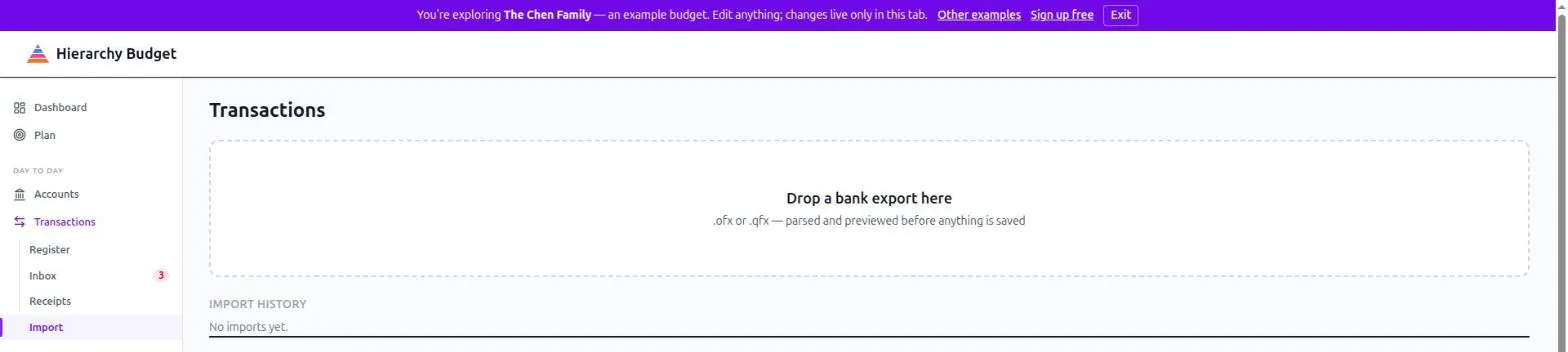
Import Data
Overview
The Import Data feature allows you to quickly populate your monthly budget by importing transaction data from CSV or Excel files. This is perfect if you’re switching from another budgeting app, have bank statements, or want to bulk-add expenses and income.
Important Limitations:
- One month at a time: Import one month of transactions per import session
- Monthly budget only: Imports go directly to your monthly budget, not to annual planning or other sections
- Category column required: You’ll need to add a Category column to your bank/credit card exports before importing
What Gets Imported
The import process handles two types of data:
Expenses
- Transaction-level data (individual purchases)
- Category summaries (pre-aggregated spending by category)
- Automatically organized into Maslow’s hierarchy levels
Income
- Income transactions (salary, freelance, dividends, etc.)
- Automatically added to your monthly income total
Supported File Formats
- CSV (.csv): Comma-separated values files
- Excel (.xlsx, .xls): Microsoft Excel workbooks
Common Sources
- Mint exports
- YNAB exports
- Bank statements (CSV format)
- Credit card statements
- Personal finance spreadsheets
The Import Process
The import follows a simple 4-step process:
Step 1: Upload Your File
- Navigate to Import Data from the main menu (or go to
/import) - Click Choose File and select your CSV or Excel file
- The file will be automatically parsed and analyzed
File Requirements:
- Must contain a Category column (or similar) with expense/income category names
- Must contain an Amount column with dollar values
- Optionally can include a Type column to distinguish income from expenses
- One month of data: Import one month of transactions at a time
Preparing Your Bank/Credit Card Data:
- Download your transactions from your bank or credit card company (usually as CSV)
- Add a Category column to your file (you can place it anywhere, even after the Amount column)
- Categorize each transaction (e.g., “Groceries”, “Gas”, “Rent”, “Salary”)
- Save the file and import it
Tip: If you import multiple months, do them one at a time. Your category mappings are saved in your browser, so the second month will automatically use the same category assignments!
Step 2: Map Your Columns
The import wizard will automatically detect common column names, but you can manually map them:
Required Mappings:
- Category Column: The column containing category names (e.g., “Groceries”, “Rent”, “Salary”)
- Amount Column: The column containing dollar amounts
Optional Mappings:
- Transaction Type Column: A column that explicitly labels rows as “Income” or “Expense”
- If not provided, the import will detect based on positive/negative amounts or amount sign
How Detection Works:
- Positive amounts = Income (e.g., $3,500.00 for Salary)
- Negative amounts = Expenses (e.g., -$450.00 for Groceries)
- Type column = Explicit classification (allows all positive amounts with a Type label)
Step 3: Assign Categories to Maslow Levels
This is where you organize your imported expenses into Maslow’s hierarchy:
The Process:
- Imported expense categories appear in an “Unmapped” section
- Drag each category to the appropriate Maslow level:
- Physiological: Food, housing, utilities, transportation
- Safety: Insurance, emergency fund, retirement savings
- Love & Belonging: Social activities, dining out, gifts
- Esteem: Personal development, fitness, education
- Self-Actualization: Charitable giving, hobbies, creative pursuits
Smart Features:
- Auto-suggestions: The system remembers your previous mappings and suggests them automatically
- Saved mappings: Your category mappings are saved in your browser’s local storage for future imports
- Reuse mappings: When you import a second month (e.g., next month’s credit card transactions), categories you’ve mapped before will automatically be assigned - no need to drag and drop again!
- Visual feedback: See which categories are mapped and which still need assignment
Income Categories:
- Income categories are automatically detected and don’t need Maslow level assignment
- They’re added directly to your monthly income total
Step 4: Review and Import
Before finalizing, review what will be imported:
Review Screen Shows:
- All expense categories and their assigned Maslow levels
- Total expense amounts by level
- All income categories and total income amount
- Summary statistics
What Happens When You Import:
- Expenses are added to your monthly budget (merged with existing categories if names match)
- Income is added to your current monthly income (cumulative)
- All data is automatically saved
- You’re redirected to your Monthly Budget to see the results
- Category mappings are saved in your browser’s local storage for future imports
Important: Imports only affect your monthly budget. They do not import to annual planning, balance sheet, or other sections. Import one month at a time.
Income Detection
The import system is smart about detecting income:
Method 1: Positive/Negative Amounts
If your file uses positive amounts for income and negative for expenses:
- $3,500.00 (Salary) → Detected as Income
- -$450.00 (Groceries) → Detected as Expense
Method 2: Type Column
If your file has a Type column:
- Type: “Income” → Always treated as income, regardless of sign
- Type: “Expense” → Always treated as expense, regardless of sign
- All amounts can be positive in this case
Method 3: Category Names
The system also recognizes common income category names:
- Salary, Wages, Paycheck
- Freelance, Consulting
- Investment, Dividend
- Bonus, Commission
- Rental Income
Category Mapping Tips
Reusing Mappings
Once you’ve mapped categories once, the system remembers:
- Future imports will auto-suggest your previous mappings
- Saves time on repeat imports
- Mappings are stored in your browser’s local storage
Handling Duplicate Categories
If you import the same category multiple times:
- The amounts are added together (merged)
- Example: Two “Groceries” entries totaling $300 and $200 become one $500 entry
Renaming Categories
You can’t rename categories during import, but you can:
- Import with the original name
- Edit the name afterward in your Monthly Budget
- Future imports will use the new name if you’ve updated it in your budget